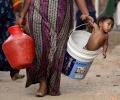
Can the newly-minted Jal Shakti ministry bring water to some 19 crore Indian households that have never had taps or heard the sound of flowing water, wonders Vinayak Chatterjee.
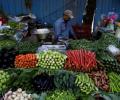
Retail inflation slowed to 4.29 per cent in April from 5.52 per cent in March, mainly due to easing food prices, government data showed on Wednesday. The Reserve Bank mainly factors in the retail inflation based on Consumer Price Index (CPI) while arriving at its monetary policy. As per the data released by Ministry of Statistics and Programme Implementation, inflation in the food basket was 2.02 per cent in April, down from 4.87 per cent in the preceding month.

The findings of the report showed consumer spending falling for the first time in over four decades in 2017-18. The government has, however, termed it a "draft" report, reports Somesh Jha.
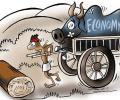
In twin blows to Indian economic revival, higher food prices drove retail inflation to a five-month high of 7.4 per cent while factory output fell for the first time in 18 months. The second consecutive month of rise in consumer price index (CPI)-based inflation will add to the pressure on the Reserve Bank of India (RBI) to again raise interest rates to tame high prices. Inflation has been above the targeted zone for the ninth month in a row and as per statute, the RBI will now have to explain to the government in writing why it failed to keep prices below 6 per cent.

As a well-wisher of the Indian Statistical System and part of the system for more than 37 years, Sunil K Sinha, former DG and CEO of NSSO, offers suggestions to improve data quality.

The inflation in the food basket spiked to 7.89 per cent in October 2019 as against 5.11 per cent the preceding month.
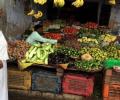
Fruits, vegetables and eggs continued to witness deflationary trend during January this year, with their prices declining 4.18 per cent, 13.32 per cent and 2.44 per cent, respectively.

Per capita income is a crude indicator of the prosperity of a country.
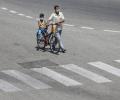
The lockdown in India has been a timely, graded, proactive and pre-emptive public health measure to fight the COVID-19 pandemic and has been part and parcel of the government's overall strategy, Dr V K Paul, Member (Health), NITI Aayog, and Chairman, Empowered Group 1, said at a media briefing on the COVID-19 situation.

According to a statement available on the Ministry of Statistics and Programme Implementation website, gross domestic product, consumer price index and index of industrial production will now be released at 5.30 in the evening.

Subramanian's paper comes at a time when concerns have been raised in various quarters about the official economic growth numbers. The Economic Advisory Council-PM said the Base Year of India's income calculations were shifted to 2011-12 on the basis of recommendations of several committees with experts in national income accounting.

Rs 7 lakh crore will be invested to develop for over 80,000 km of highways including Bharatmala project in the next five years
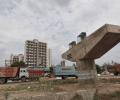
If 4,000 workers could work round the clock for the construction of the new Parliament building, then there is no reason why all infrastructure projects too cannot follow that model, asserts Dr Sudhir Bisht.

Department of Economic Affairs secretary Atanu Chakraborty said that equity capital flows have been positive this year.

Our Rediff labs team analysed 2014 data from the Ministry of Statistics and Programme Implementation on the participation of women in decision making at administrative levels in India in three different sectors.
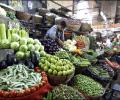
Retail inflation in pulses and products category rose to a staggering 42.20 per cent in October.

Roads and national highways are the lifeline of the country, says Oscar Fernandes.
Data on the new series given by a panel on real sector statistics shows that GDP grew by 10.23 per cent in 2007-08 and 10.78 per cent in 2010-11. There are some years for which the new figures show a deceleration in growth as well. The new series has 2011-12 as the base year while the earlier series had 2004-05 and 1993-94.
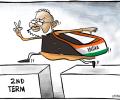
The government's decision to release the reports comes two days after over 200 scholars from across the globe issued a statement demanding release of all withheld reports produced by the NSO, including the household consumer expenditure survey that was junked.

The retail inflation rate breached the 6 per cent upper tolerance limit of the RBI for the first time in seven months in January, while the wholesale price index stayed in double-digits for the 10th month in a row, showed two sets of data released by the government on Monday. Retail inflation, the key input for the RBI while reviewing the repo rate every two months, soared during the month mainly because of a spike in certain food items. The previous high for retail inflation was 6.26 per cent in June 2021.

Take a look at the map to see just how green is your area?

India's per capita income, a gauge for assessing standard of living, for 2013-14 is up at Rs 6,699 per month for 2013-14 as against the earlier estimate of Rs 6,198.33 after the government updated the base year for measuring national accounts.
Most economists were of the view that the NSSO should release the data, as any move to withhold it will dent the image of country's statistical system.

CPI inflation is on the decline since July.

The overall consumer food inflation in August fell to 5.91 per cent as against 8.35 per cent in July

The IIP data showed a significant slowdown in the manufacturing sector, which grew at 4.2 per cent in July 2019 as compared to 7 per cent a year ago.

The NSSO had enumerated 79,306 households in rural areas and 45,374 in urban regions.

There was a slowdown in the manufacturing sector, which grew at 1.2 per cent in June 2019 as compared to 6.9 per cent a year ago.

There has been no discussion so far on cutting Plan expenditure, the Planning Commission said on Thursday even as it asked states to maintain fiscal discipline.

Rajiv Kumar will continue as vice-chairman of the body, along with other full-time members V K Saraswat, Ramesh Chand and V K Paul.

Retail inflation rises to 4.41% in Sep on dearer food items
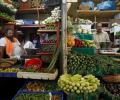
The decline in retail inflation has been mainly on account of falling prices of vegetables and pulses

The National Council of Applied Economic Research (NCAER) on Thursday lowered the GDP projection for the current fiscal to 4.7-4.9 per cent due to exchange rate depreciation.
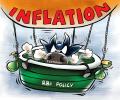
Currently, the retail inflation is well below the RBI's comfort level. The government has asked the central bank to keep inflation in the range of 4 per cent.

Food inflation was 7.79 per cent last month, higher than a revised 7.47 per cent in May

Discrepancies in the statistical GDP data refer to the difference in national income under production method and expenditure method.

The Indian economy has recovered 'handsomely' from the pandemic-induced disruptions, former Niti Aayog vice chairman Arvind Panagariya said on Tuesday, while expressing hope that the recovery will be sustained and the growth rate of 7 to 8 per cent will be restored. Panagariya suggested that the government must now signal its intention to wind down fiscal deficit by cutting it by half-to-one percentage point in 2022-23. "The Indian economy has recovered handsomely, returning to its pre-COVID GDP... "Only private consumption is still below its pre-COVID-19 level," the eminent economist told PTI in an interview.

In the third reshuffle since coming to power, Prime Minister Modi raised the strength of his Council of Ministers from 73 to 76.
The retail inflation, which is factored in by the RBI to arrive at its monetary policy, has been on decline since last month. The previous low was 5.54 per cent in November 2019. The government has asked the RBI to restrict the inflation around 4 per cent, with a margin of 2 per cent on the either side.

The central government has made Intelligence Bureau's clearance mandatory for appointment of a private person as Officer on Special Duty (OSD) to a minister.
